


















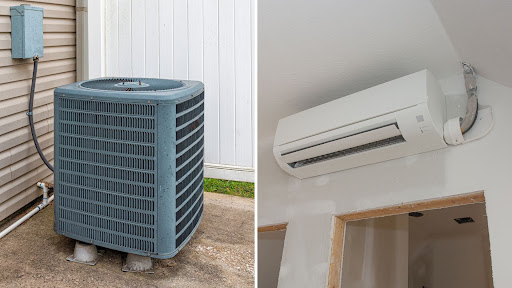
Summer heat has a way of exposing a home’s weakest link. Maybe it’s an old window unit rattling in the frame. Maybe it’s a room that never quite cools down no matter how low the thermostat goes. Whatever the trigger, a lot of homeowners end up facing the same choice: stick with traditional central air, or switch to a ductless mini split system.
Both options cool a home well. But they work in very different ways, and the right choice depends on the home itself.
How Central Air Actually Works
Central air conditioning uses one central unit to cool an entire home. Air travels through a network of ducts hidden behind walls, floors, and ceilings. A single thermostat controls the temperature for the whole house.
This setup works great in homes already built with ductwork. It’s simple to control and familiar to most homeowners. The tradeoff comes from the ducts themselves. Air has to travel a long way before it reaches a vent, and that trip isn’t always efficient.
According to ENERGY STAR, a joint program of the U.S. Environmental Protection Agency and the U.S. Department of Energy, about 20 to 30 percent of the air moving through a duct system is lost due to leaks, holes, and poorly connected ducts. This is especially true when ducts run through hot attics or unconditioned spaces. That’s a meaningful chunk of cooled air never actually making it into a living room.
How Ductless Mini Splits Work Differently
A ductless mini split skips ductwork entirely. Instead, small indoor units mount directly on a wall or ceiling in each room. An outdoor compressor connects to these units through a slim refrigerant line, usually run through a small hole in an exterior wall.
Each indoor unit can be controlled separately. That means one room can stay cooler than another, something central air simply can’t do without a zoned system. Because there’s no ductwork involved, mini splits avoid the energy loss that comes with air traveling through long duct runs.
When Central Air Makes More Sense
Central air tends to be the better fit for larger homes that already have ductwork in place. Installing brand-new ductwork in a home that doesn’t have any is expensive and invasive, often requiring walls or ceilings to be opened up.
Homeowners who want one thermostat controlling the whole house also tend to prefer central air. It’s a simpler system to operate day to day, and most HVAC technicians are deeply familiar with maintaining it.
When a Ductless Mini Split Makes More Sense
Older homes without existing ductwork are prime candidates for a ductless system. So are home additions, converted garages, sunrooms, or any space that was never connected to a home’s original HVAC setup.
Mini splits also shine in homes where different rooms have very different cooling needs. A sunroom that bakes in the afternoon sun and a basement that stays naturally cool don’t need the same amount of cold air. A ductless mini split system lets each space get exactly what it needs instead of forcing one setting across the entire house.
Comparing Installation and Cost
Central air installation costs vary widely depending on whether ductwork already exists. Retrofitting an old home with new ducts can rival or exceed the cost of the equipment itself. In homes that already have ductwork, replacing an existing central air system is usually more straightforward.
Ductless mini splits cost more per unit than a single central air system, but installation itself tends to be faster and less invasive. No ductwork means no need to tear into walls or ceilings. For homes needing to cool just one or two rooms, a mini split can actually come out cheaper overall.
Comparing Long-Term Efficiency
Mini splits generally win on efficiency, largely because they skip the energy loss tied to ductwork. Homeowners often notice a real difference on their utility bills after switching, especially if their old ducts were leaky or poorly insulated.
Central air can still be efficient, especially in a well-sealed home with properly maintained ductwork. Regular maintenance, like sealing duct leaks and changing filters, helps close much of the efficiency gap between the two systems.
Noise and Appearance
Central air systems stay mostly out of sight, with only vents visible inside the home. The outdoor compressor sits outside, similar to a mini split’s outdoor unit. There’s nothing to see indoors beyond a grille in the wall or ceiling.
Ductless mini splits are more visible. The indoor units mount directly on a wall, which some homeowners love for the sleek, modern look and others find less appealing than a hidden vent. Newer models tend to be quieter than older units, but they still generate slightly more visible presence in a room than a central air vent does.
Making the Right Call for Your Home
There’s no single answer that fits every house. A large home with existing ductwork usually leans toward central air. An older home without ducts, an addition, or a space with wildly different cooling needs from room to room usually leans toward a mini split.
The best approach is to think honestly about the home’s layout, existing infrastructure, and how differently each room actually needs to be cooled. Getting that assessment right upfront saves both money and frustration down the road. It’s often worth a conversation with an HVAC professional who can look at the specific home before making a final call.